No content results match your keyword.
Content

You have successfully logged out.


Not registered yet?
Advanced Surface Technology
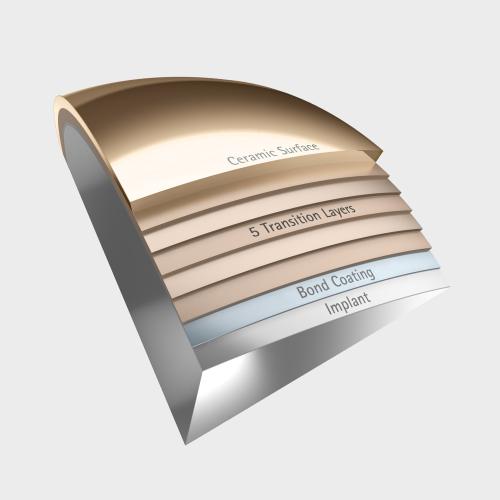
Advanced Surface Technology is an innovative multilayer coating for knee implants that is unique in the market. With improved mechanical properties and fantastic results in biocompatibility – it is an effective solution to minimise complications in primary and revision surgery.
This information is meant for medical professionals only. Please confirm that you are a medical professional before accessing the information.
Confirm Yes, I am a health care professional. Cancel No, I am not a health care professional.
7 layers for protection
Unlike monolayer coatings, the AS 7-layer coating with Zirconium Nitride surface (ZrN) has a buffer zone which compensates the changes in surface hardness and results in more resilient elastic properties. In addition, the transition layers act as an improved metal ion barrier and offer a more efficient metal ion reduction than monolayer coatings with Titanium Niobium Nitride surface (TiNbN). [1], [2]


Enhanced biocompatibility
It has been discovered that a possible contact allergy to implant materials or the components contained in bone cement may lead to implant intolerance. Endoprostheses are known to release metal ions into the human body. This can lead to immune reactions in patients who are at risk of hypersensitivity. The metal hypersensitivity prevalence among the general population is relatively high at 13%. [3] 60% of patients with complications after metal implants are sensitive to metals. [4]

With AS Technology, metal ion concentration is near the level of detection and below biological threshold. [2] The material with excellent biocompatibility seals the metallic components, providing an effective metal ion barrier.

One of the most commonly identified pathogens responsible for orthopaedic implant infection is Staphylococcus epidermidis, which can form biofilms on surfaces and lead to medical problems. The AS surface with zirconium nitride top coat showed 45% lower biofilm formation compared with standard uncoated CoCrMo implants. [5]

Interleukins (IL-x) are endogenous messenger substances of the cells of the immune system. Elevated levels of interleukin in the blood indicate the presence of an inflammatory reaction. Using implants with Advanced Surface Technology means potentially reduced pro-inflammatory triggering. [6]

AS wear solution
The wear of the gliding surface is directly linked to aseptic loosening due to osteolysis triggered by polyethylene wear particles. Aseptic loosening is the most common reason for revisions in TKA. [7], [8] The interaction of components is therefore very important for the results of a knee surgery and the patient's well being.
The zirconium nitride top coat yields superior surface hardness. The wear rate is reduced by up to 88% compared to standard implants.
0%
AS knee implants demonstrate up to 88% reduction in wear when compared to CoCrMo prosthesis. [9]
The combination of AS Technology for the femur and tibia component and the beta sterilization procedure for our gliding surface yields to superior performance. Beta radiation uses higher concentrated, lower penetrating radiation levels for reduced oxidation im aged material. It combines the advantage of low wear with good mechanical properties of conventional polyethylenes.
0%
Beta PE provides 70% reduction in oxidation levels. [10]
AS clinical evidence
The clinical performance is very important – not only for the surgeon that aims for a good result after surgery, but also for the patient that needs the confidence to make the right choice for his/her health. There are many different studies and papers to prove the effectiveness and advantages of Advanced Surface Technology.
AS implant portfolio
The AS coating technology can be applied to all implant components. It is important for us to let you decide for your preferred AESCULAP® knee implant system – with the option in AS.
[1] Ragone V, Canciani E, Biffi CA, D'Ambrosi R, Sanvito R, Dellavia C, Galliera E. CoCrMo alloys ions release behavior by TiNbN coating: an in vitro study. Biomed Microdevices. 2019 Jul 4;21(3):61.
[2] Reich J, Hovy L, Lindenmaier HL, Zeller R, Schwiesau J, Thomas P, Grupp TM. Präklinische Ergebnisse beschichteter Knieimplantate für Allergiker [Preclinical evaluation of coated knee implants for allergic patients]. Orthopade. 2010 May;39(5):495-502.
[3] Schäfer T, Böhler E, Ruhdorfer S, Weigl L, Wessner D, Filipiak B, Wichmann HE, Ring J. Epidemiology of contact allergy in adults. Allergy. 2001 Dec;56(12):1192-6.
[4] Hallab N, Merritt K, Jacobs JJ. Metal sensitivity in patients with orthopaedic implants. J Bone Joint Surg Am. 2001 Mar;83-A(3):428-36.
[5] Pilz M, Staats K, Tobudic S, Assadian O, Presterl E, Windhager R, Holinka J. Zirconium Nitride Coating Reduced Staphylococcus epidermidis Biofilm Formation on Orthopaedic Implant Surfaces: An In Vitro Study. Clin Orthop Relat Res. 2019 Feb;477(2):461-466.
[6] Thomas P, Hisgen P, Kiefer H, Schmerwitz U, Ottersbach A, Albrecht D, Summer B, Schinkel C. Blood cytokine pattern and clinical outcome in knee arthroplasty patients: comparative analysis 5 years after standard versus "hypoallergenic" surface coated prosthesis implantation. Acta Orthop. 2018 Dec;89(6):646-651.
[7] Sadoghi P, Liebensteiner M, Agreiter M, Leithner A, Böhler N, Labek G. Revision surgery after total joint arthroplasty: a complication-based analysis using worldwide arthroplasty registers. J Arthroplasty. 2013 Sep;28(8):1329-32
[8] Australian Orthopaedic Association National Joint Replacement Registry (AOANJRR). Hip, Knee & Shoulder Arthroplasty: 2022 Annual Report, Adelaide; AOA, 2022: 1-487.
[9] Grupp TM, Giurea A, Miehlke RK, Hintner M, Gaisser M, Schilling C, Schwiesau J, Kaddick C. Biotribology of a new bearing material combination in a rotating hinge knee articulation. Acta Biomater. 2013 Jun;9(6):7054-63.
[10] Blömer W, Lohrmann E. Verschleißbeständigkeit von UHMWPE-Artikulationen in der Hüftgelenksendoprothetik. In: Weller S, Braun A, Eingartner C, Maurer F, Weise K, Winter E, Volkmann R. Das BICONTACT Hüftendoprothesensystem 1987-2007. Stuttgart: Georg Thieme Verlag; 2007. p. 94-100.
[11] Australian Orthopaedic Association National Joint Replacement Registry (AOANJRR). Hip, Knee & Shoulder Arthroplasty: 2021 Annual Report, Adelaide; AOA, 2021: 1-432.
[12] Lützner J, Beyer F, Lützner C, Tille E, Postler AE. A Novel Multilayer-Coating for Total Knee Arthroplasty Implants is Safe – 10-Year Results From a Randomized-Controlled Trial. J Arthroplasty. 2023 Jan;38(1):90-95.e1.
[13] Whiteside LA. Clinical Results of Revision TKA in Patients With Presumed Metal and Cement Allergy. J Arthroplasty. 2022 Jun;37(6S):S250-S257.