No content results match your keyword.
Content

You have successfully logged out.


Not registered yet?
AV fistula catheter
Each dialysis patient spends up to 624 hours a year at the renal care center for their life-saving treatment. During this time, their fistula is cannulated about 300 times (assumption: three treatments per week). Every dialysis session can be particularly stressful, both for the patient but also for the nursing staff, because this complex procedure is never routine.
Needlestick injuries can happen to anyone at any time. They can be caused by patient-related factors, such as anxious or restless patients, an inadvertent bump from a passing colleague, or concealed sharps.
This information is meant for medical professionals only. Please confirm that you are a medical professional before accessing the information.
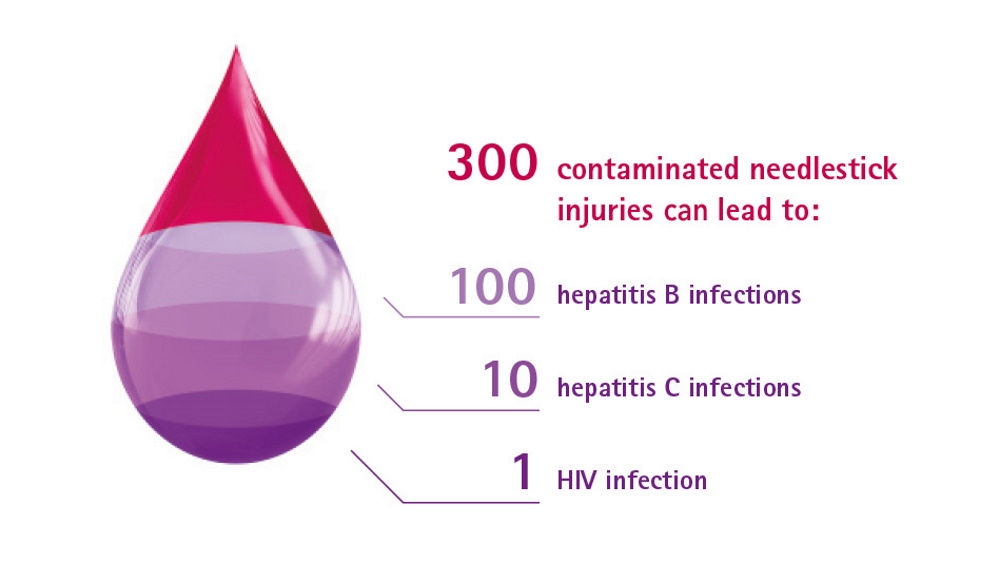
Confirm Yes, I am a health care professional. Cancel No, I am not a health care professional.Another area of concern is possible infections transmitted by needlestick injuries. Thus, the main issue with needlestick injuries (NSI) might not be the trauma or injury itself, but rather the percutaneous exposure of a patient’s blood or body fluids, which may carry infectious agens.2, 4, 7
Diacan® Flex
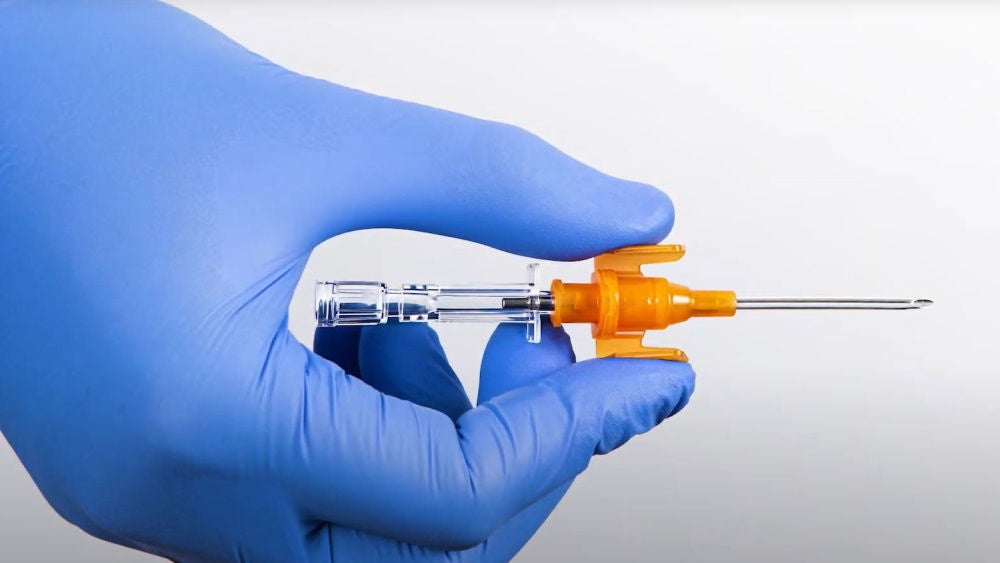
Diacan® Flex is equipped with an integrated protective mechanism that automatically covers the needle tip immediately after withdrawal, as well as a built-in blood control valve that help prevent blood leakage when the tube is removed.
In the medical field, up to three million needlestick injuries are reported annually and each of these can result in the transmission of pathogens.5
According to a communication of the Canadian Center for Occupational Health and Safety (CCOHS), more than 20 different agents, including viruses, bacteria, protozoa, and fungi, have been transmitted to healthcare workers (HCWs) through NSI.2
In the dialysis population, the incidence rate for hepatitis C (HCV) is a major concern.8 Compared to the incidence rate in the general population, the risk of an HCV infection for healthcare workers in dialysis is much higher.
The relatively high rate of hepatitis C compared to the general population can be attributed in part to the general condition of dialysis patients, which puts them at a higher risk to be infected than in other patients, and the fact that dialysis patients are mostly screened more frequently for Hepatitis C than the general population.
Nevertheless, studies show that dialysis health care workers are at risk to experience a high-risk percutaneous injury.7,9,10 This also occurs with common dialysis catheters or other vascular access devices. These devices can carry large volumes of potentially infectious material due to the hollow needle and the large gauge.8
Pathogens or diseases transmitted to healthcare workers after needlestick injuries reported by the Canadian Center for Occupational Health and Safety (CCOHS):2
Every NSI involves extra costs, which can vary from 15 euros in cases of self-treatment measures up to 922,000 euros per case for long-term treatments and disability payments.11
Direct and indirect costs caused by NSI can put major pressure on the healthcare budget every year. The direct costs, such as follow-up diagnosis procedures and medical treatments, are often a consequence of recommended NSI procedures and therefore may have a greater impact on the healthcare facility.
Indirect costs resulting from NSI must also be considered. This can include the post-injury impact on the employment, compensation for lost employment and other damages, increased insurance premiums, and future litigation. Furthermore, even if no disease is transmitted, emotional trauma and suffering can occur in affected persons. This may lead to personal counseling and loss of productivity.
More patient comfort
For some patients, it is just a little sting, for others it remains a difficult moment during every treatment.
It only takes a moment to puncture the fistula, but this usually happens about 300 times a year. Therefore, it is very important to keep both the psychological and physical stress as low as possible.
Diacan Flex was developed to increase patient comfort and reduce the risk of vascular injury. After the catheter is placed, the needle is removed and only the plastic capillary stays in the fistula. Its soft material and holes on the side help to protect the vein and the risk of perforation and infiltration can be reduced, even if the patient moves the arm.
Less packaging waste
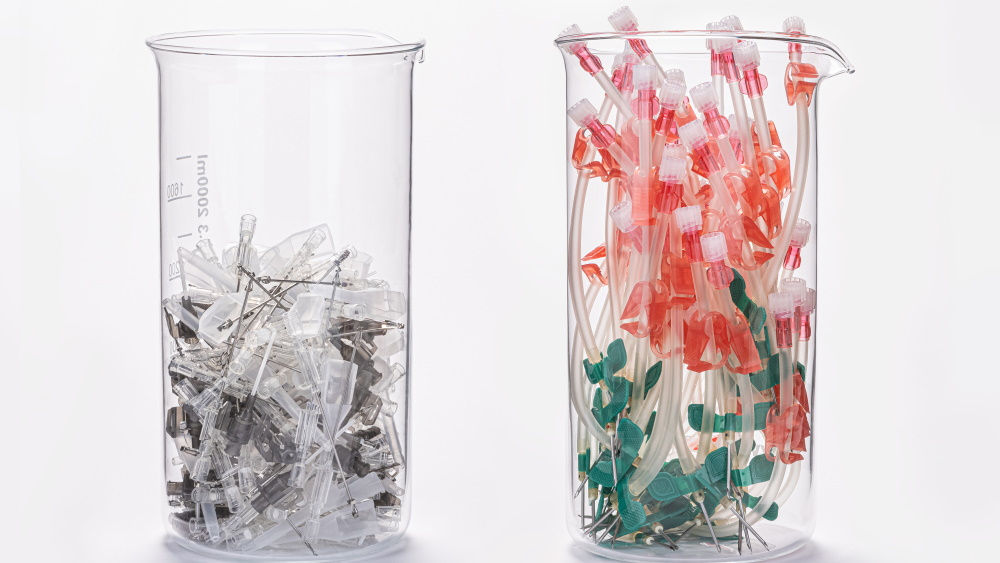
Like many other medical products, a dialysis catheter or needle can only be used once and has to be thrown away after the treatment. Due to its compact design, Diacan Flex can reduce waste.
Compared to a conventional steel needle (B. Braun Diacan Pro Needle), Diacan Flex weighs 6.66 grams less. On average, a patient requires 156 treatments per year, using two needles each time. This means the annual contaminated waste per patient can be reduced by approximately 2.08 kilograms.
Diacan® Flex

Diacan® Flex
[1] Wittmann A, Hofmann F, Kralj N. Needle stick injuries--risk from blood contact in dialysis. J Ren Care. 2007 Apr-Jun;33(2):70-3. doi: 10.1111/j.1755-6686.2007.tb00043.x. PMID: 17702509.
[2] Canadian Center for Occupational Health and Safety (CCOHS). Needlestick injuries. 2000. (www.ccohs.ca/oshanswers/diseases/needlestick_injuries.html)
[3] Langgartner J, Audebert F, Schölmerich J, Glück T. Dengue virus infection transmitted by needle stick injury. J Infect. 2002 May;44(4):269-70. doi: 10.1053/jinf.2002.0994. PMID: 12099738.
[4] Jagger J, Hunt EH, Brand-Elnaggar J, Pearson RD. Rates of needle-stick injury caused by various devices in a university hospital. N Engl J Med. 1988 Aug 4;319(5):284-8. doi: 10.1056/NEJM198808043190506. PMID: 3393183.
[5] Prüss-Ustün A, Rapiti E, Hutin Y. Estimation of the global burden of disease attributable to contaminated sharps injuries among healthcare workers. Am J Ind Med. 2005 Dec;48(6):482-90. doi: 10.1002/ajim.20230. PMID: 16299710.
[6] Iinuma Y, Igawa J, Takeshita M, Hashimoto Y, Fujihara N, Saito T, Takakura S, Ichiyama S. Passive safety devices are more effective at reducing needlestick injuries. J Hosp Infect. 2005 Dec;61(4):360-1. doi: 10.1016/j.jhin.2005.04.019. Epub 2005 Sep 13. PMID: 16165248.
[7] Chalupka SM, Markkanen P, Galligan C, Quinn M. Sharps injuries and bloodborne pathogen exposures in home health care. AAOHN J. 2008 Jan;56(1):15-29; quiz 31-2. doi: 10.3928/08910162- 20080101-02. PMID: 18293597
[8] McCleary J, Caldero K, Adams T. Guarded fistula needle reduces needlestick injuries in hemodialysis. Nephrol News Issues. 2002 May;16(6):66-70, 72. PMID: 12035629.
[9] Perry J, Parker G, Jagger J. Percutaneous injuries in home healthcare settings. Home Healthc Nurse. 2001 Jun;19(6):342-4. doi: 10.1097/00004045-200106000-00005. PMID: 11985229.
[10] Perry J, Parker G, Jagger J. EPINet Report: 2001 Percutaneous Injury Rates. Advances in exposure prevention 2003;6(3):32-36
[11] Hatcher IB. Reducing sharps injuries among health care workers: a sharps container quality improvement project. Jt Comm J Qual Improv. 2002 Jul;28(7):410-4. doi: 10.1016/s1070-3241(02)28041-4. PMID: 12101553;